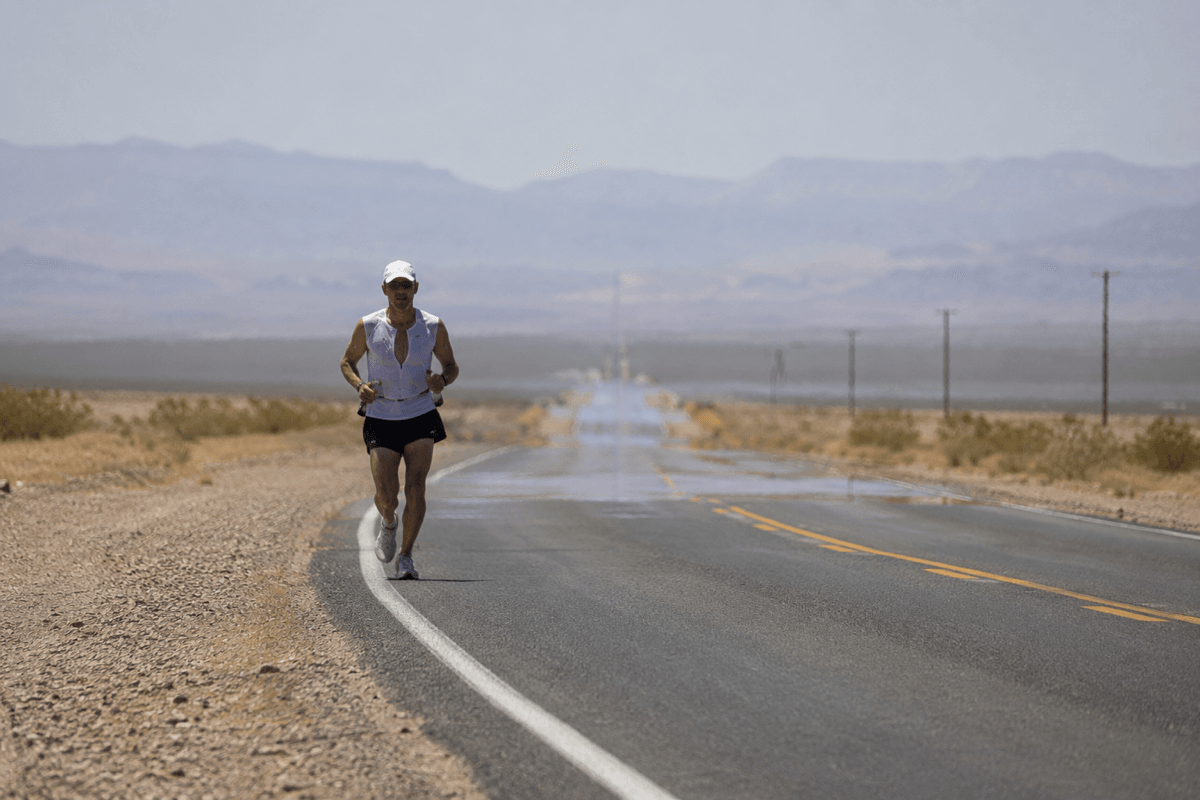
It is 30 °C, full sun, and this was only supposed to be an easy run. A few minutes in, your shirt is already wet. The stretch with no shade feels longer than it is. Even a small rise in the road pushes your breathing up more than it should.
So you do what a lot of runners do. You hold pace a little longer and wait for the body to settle. Most of the time it does not. What was meant to be an easy run turns into work.
That is the core problem with hot-weather training. The session often changes before the watch makes that obvious. If you adjust late, the easy run stops being easy, the workout stops being clean, and the long run starts leaving a bigger mark than the rest of the week can absorb.
Key takeaways
- In the heat, pace usually has to come down before effort does. Slow down early or the run stops being the run you planned.
- Easy runs need the biggest ego check. Protect the session before you protect the pace.
- Workouts often need an earlier start, more shade, shorter reps, longer recoveries, or an indoor fallback like a treadmill and fan.
- Humidity matters almost as much as temperature because sweat only cools you if it can evaporate.
- The first hot runs of the season are usually the roughest. Give adaptation a little time instead of forcing normal pace too soon.
Table of contents
- Who this is for
- Why this matters
- What the heat changes in the body
- When target pace stops helping
- A simple decision framework for hot days
- How to adjust easy runs, workouts, and long runs
- Hydration, sodium, and the overdrinking trap
- Give it a week or two
- Red flags: when to stop or change the plan
- FAQ
- References
Who this is for
This article is for you if:
- easy runs stop feeling easy much earlier than they should once the weather turns hot
- you are not sure whether to slow down, shorten the run, or change the session entirely
- your workouts and long runs stop going the way they should in hot weather, and you want practical adjustments instead of vague advice to be careful
This article is not for you if:
- you are mainly looking for a race-specific heat-acclimation protocol rather than day-to-day training adjustments
Why this matters
When summer arrives, training does not stop. The weather changes, but you still want to keep building your fitness. Running early, before the day heats up, can help. But that is not always realistic. Work gets in the way, your only slot may be later, or you are simply not someone who wants to run at five in the morning.
The problem usually starts when you try to keep everything else the same. Same pace, same route, same start time, same drink plan, same fueling. Then the run ends up harder than it was supposed to.
The cost does not stay inside one run. The easy run stops being easy. During a workout, you stop doing the work you came to do and start dealing with the conditions. In a long run, drinking and eating need more attention, and the whole session can leave a bigger mark than the rest of the week can absorb. You are not out there just to get through hot runs. You still want the session to do its job.
What the heat changes in the body
During running, most of the energy you produce ends up as heat, not forward motion. On a hot day the body has to work harder to get rid of it. If the air is humid, it gets harder again because sweat only cools you if it can evaporate.
You notice that first in breathing and heart rate. More blood has to go toward cooling, while the muscles still need it too. So even when pace looks manageable, the body is already working harder to hold it.
Stay out long enough and the gut gets involved as well. Then drinking and eating both need more attention. Food that normally goes down without much thought can start sitting badly or becoming less appealing. Drinking can get less comfortable too, especially once the fluid gets warm or the stomach starts pushing back. That is when regular intake starts getting harder to maintain. If this becomes a recurring problem in long sessions, it usually helps to look at pacing together with an ultramarathon fueling strategy rather than treating it as a gel problem alone.
When target pace stops helping
Pace is often the first thing you need to give up on a hot day. If you hang on to it too long, the session changes before the watch makes that obvious.
Heart rate can help, but only if you read it with some common sense. Heat pushes it up sooner and keeps nudging it higher. That is why the same pace can look steady while the effort keeps climbing underneath it. The real question is whether the run is still doing the job it was meant to do. Is it still easy? Is the workout still controlled? Are you still setting the long run up well enough to finish it properly? If the answer is no, change the run right away.
This is also why the forecast matters more than many runners admit. A quick check of the weather and thermal conditions before you start is often more useful than pretending the plan written in cool weather still applies unchanged.
A simple decision framework for hot days
Before you head out, run the day through a few quick checks. It takes a minute and it saves many of the bad decisions that would otherwise show up halfway through the run.
Inputs
- forecast temperature and humidity at your actual start time
- session type
- expected duration
- shade and refill options on the route
Rules
- If it is an easy day and the forecast is hot, drop the pace expectation before you start and run by feel.
- If it is a quality session and you can move it earlier, indoors, or into shade, do that before changing the workout itself.
- If you cannot move it, shorten the reps slightly and lengthen the recoveries. Judge the session by the quality of the work, not the splits.
- If it is a long run over two hours, plan fluid access first, route second, and pace last.
- If mid-run the effort keeps climbing while pace drops, the decision has already been made for you. Back off or cut it short.
Exceptions
- the first truly hot week of the season, when everything feels worse than the thermometer suggests
- deliberate race-specific heat preparation, where controlled heat exposure is the actual point
Examples
- A hot easy run on rolling terrain is often better paced by breathing and relaxed mechanics than by your usual average pace.
- On hilly routes, a grade-adjusted pace calculator can help you see why a climb that looks slow on the watch may still be too costly for the day.
How to adjust easy runs, workouts, and long runs
| Session type | Best anchor | Useful adjustment | Common mistake |
|---|---|---|---|
| Easy run | RPE, breathing, relaxed mechanics | Slow down freely and shorten the route if needed | Letting an easy run drift out of easy |
| Tempo or interval session | Quality of the work, not exact split | Start earlier, shorten reps, extend recovery, or move indoors | Forcing the planned session instead of protecting the quality |
| Long run | Time on feet, fueling, stable effort | Carry more fluid, plan loops, hike climbs earlier, lower pace expectations | Turning the day into an unplanned heat stress test |
That is the job in summer. Keep the session true to its purpose.
Easy runs
Easy mileage is there to support the week. On hot days that often means slowing down earlier than you want to. If you wait until the run is obviously too hard, you waited too long.
One overheated easy run does not make you tougher. It just adds fatigue to days that were supposed to stay clean.
Tempo and interval sessions
Tempo and interval sessions are where heat bites hardest. Intensity and heat stack on top of each other very quickly. If the point is quality, set the day up so quality is still possible.
Start earlier. Find shade. Use a treadmill and a fan if that gives you the better session. If you stay outside, shorten the reps a little and lengthen the recovery a little. If the conditions are bad enough, change the session. Adjusting one workout rarely hurts a block. Forcing one often does.
Long runs
Long runs expose every weak spot in the heat. Fluid access and gut tolerance matter more, and pacing mistakes show up earlier. Start earlier if you can. Build loops if you need refills. On hilly routes, hiking climbs earlier than usual is often the smarter call, and the run-walk calculator can help you think more clearly about where that switch may happen.
Cooling matters too. A cap, hat, or other sun cover can help, even if it does not always feel cooler at first. The point is to reduce direct sun exposure on the head and make cooling easier. When you pass a stream or fountain, soak the cap or buff. Putting ice under the cap or into a buff around the neck is often one of the simplest cooling tricks you can use.
On very hot days, average pace does not tell you much. Better checks are whether you can still eat, still drink without forcing it, and still move well enough to finish the second half the way you wanted.
Hydration, sodium, and the overdrinking trap
For most ordinary training runs, thirst is a reasonable starting point. On longer or hotter runs, plan fluid access ahead of time so you do not run dry before you have a realistic chance to refill. Warm fluid in a flask can get unpleasant fast in the sun, and that alone can throw off your drinking rhythm.
If you are out for hours and sweating heavily, some sodium in drink or food may help, especially if you already know you are a salty sweater. But the bigger mistake in the heat is usually not too little sodium. It is forcing too much plain water because the day feels hot. That can dilute blood sodium, which is how hyponatremia develops. In severe cases, that can be more dangerous than ordinary dehydration. Electrolytes support a sound plan; they do not rescue a run that is simply too hard for the conditions.
If fueling starts getting shaky, start with the obvious fixes. Lower the intensity. Use smaller doses more often. Dilute concentrated carbohydrates. Cool the body more aggressively. Very often the problem is not the gel. The heat and the pace have already pushed the gut out of its comfort zone.
Give it a week or two
The first hot runs of the season can make you think something is wrong. Heart rate jumps early. Breathing gets loud sooner. A pace that was fine in cooler weather suddenly is not.
Usually that changes faster than you think. If you keep training and stop forcing normal pace, the first shift often comes within a few runs. Heart rate settles a bit sooner. The whole thing stops feeling quite so abrupt. The more noticeable change usually comes after about one to two weeks of repeated heat exposure, depending on the runner and the conditions.
That is why you do not need to prove anything in the first stretch of hot weather. Let the body catch up. Keep training, keep adjusting, and give the process a little time.
Red flags: when to stop or change the plan
Some days just need an adjustment. A few signs mean you should stop.
- Back off or change the session if heart rate is far above normal for the day, thermal discomfort keeps climbing, and pace is dropping anyway.
- Change the run if you can tell early that it is no longer matching its purpose. The easy run is drifting moderate, the workout is falling apart, or the long run has turned into a job of just getting home.
- Stop immediately if there is confusion, disorientation, irrational behavior, loss of coordination, or suddenly poor decisions. If symptoms do not settle quickly after stopping and cooling down, seek medical help.
- Repeated vomiting, severe dizziness, chills or goosebumps in obvious heat, or a headache that keeps building also deserve real caution.
Good fitness can hide the problem for longer. It does not protect you from it. Heat also chips away at judgment, which is one more reason to change the run early instead of waiting until things are obvious.
If pain, dizziness, GI distress, or heat symptoms keep escalating instead of settling, reduce the session or stop and get assessed by a qualified medical professional.
FAQ
This article is educational and based on the available scientific literature. It does not replace medical advice, race-organizer assessment, or individual risk evaluation. If you have any health concerns, consult a sports physician.
References
- Gonzalez-Alonso J. The cardiovascular challenge of exercising in the heat. Journal of Physiology. 2008. DOI: 10.1113/jphysiol.2007.142158.
- Ely MR, Cheuvront SN, Roberts WO, Montain SJ. Impact of weather on marathon-running performance. Medicine & Science in Sports & Exercise. 2007. PMID: 17473775.
- Ely MR, Martin DE, Cheuvront SN, Montain SJ. Effect of ambient temperature on marathon pacing is dependent on runner ability. Medicine & Science in Sports & Exercise. 2008. PMID: 18685522.
- El Helou N et al. Impact of environmental parameters on marathon running performance. PLoS ONE. 2012. DOI: 10.1371/journal.pone.0037407.
- Periard JD, Racinais S, Sawka MN. Adaptations and mechanisms of human heat acclimation. Scandinavian Journal of Medicine & Science in Sports. 2015.
- McDonald T et al. Influence of exercise heat acclimation protocol characteristics on adaptation kinetics. Comprehensive Physiology. 2025. PMID: 40442924.
- Daanen HAM, Racinais S, Periard JD. Heat acclimation decay and re-induction. Sports Medicine. 2018. PMID: 29129022.
- Zurawlew MJ, Walsh NP, Fortes MB, Potter C. Post-exercise hot water immersion induces heat acclimation and improves endurance exercise performance in the heat. Scandinavian Journal of Medicine & Science in Sports. 2016. PMID: 26661992.
- Hew-Butler T et al. Statement of the Third International Exercise-Associated Hyponatremia Consensus Development Conference. Clinical Journal of Sport Medicine. 2015.
- Hoffman MD, Stuempfle KJ, Valentino T. Sodium intake during an ultramarathon does not prevent muscle cramping, dehydration, hyponatremia, or nausea. Sports Medicine Open. 2015. DOI: 10.1186/s40798-015-0040-x.
- Periard JD et al. Exertional heat stroke: pathophysiology and risk factors. British Journal of Sports Medicine. 2023. PMID: 36936589.
- Casa DJ et al. National Athletic Trainers' Association position statement: exertional heat illnesses. Journal of Athletic Training. 2015.
Related