ENDURING MOTION
Eiger Ultra Trail E101 course above a glacier in the Bernese Oberland
Race Hub · 2026

Eiger Ultra Trail E101 2026: Course & Strategy

This page brings the publicly available information for the Eiger Ultra Trail E101 2026 into one place, organised by the questions that matter before the start: course, cut-offs, mandatory kit, weather and the final two weeks of preparation.

Distance101 km
Elevation gain6,700 m D+
Start18 July 2026, 04:00
Time limit25 hours
Elevation profile

Course · 101 km · 6,700 m D+

One loop from Grindelwald (1,034 m) around the Eiger massif. Move the cursor (or use the arrow keys ←/→) across the profile to reveal distance, elevation and the next checkpoint with its cut-off.

steep climbclimbrollingdescent
drop bagwater onlycut-off

E101 2025 (V2) GPX analysis: 99.2 km and roughly 6,200 m D+. Organiser figures: 101.6 km and 6,700 m D+.

Three key segments, read from the GPX data
  1. 01

    First climb · straight from the start

    km 0 – 9·+950 m climb·Grindelwald 1,034 m → 1,980 m

    The course climbs practically from the start line. Running the first nine kilometres above your threshold gets repaid in the second half, where every kilometre costs noticeably more.

  2. 02

    High point of the course · exposed above 2,000 m

    km 18 – 34.5·+1,150 m in two steps·high point 2,674 m

    The longest continuous stretch above 2,000 m. Altitude, exposure and the July thunderstorm risk meet here. Wind and rain protection belongs within reach, not at the bottom of the pack.

  3. 03

    Second half · from the low point back up high

    km 54 – 80·≈2,000 m of climb from the 895 m low point·biggest single climb +950 m (km 63 – 67)

    From the lowest point of the course the decisive climbing arrives on tired legs. After that there is still a descent of more than 1,000 m (km 84 – 91) and a final counter-climb at km 91.

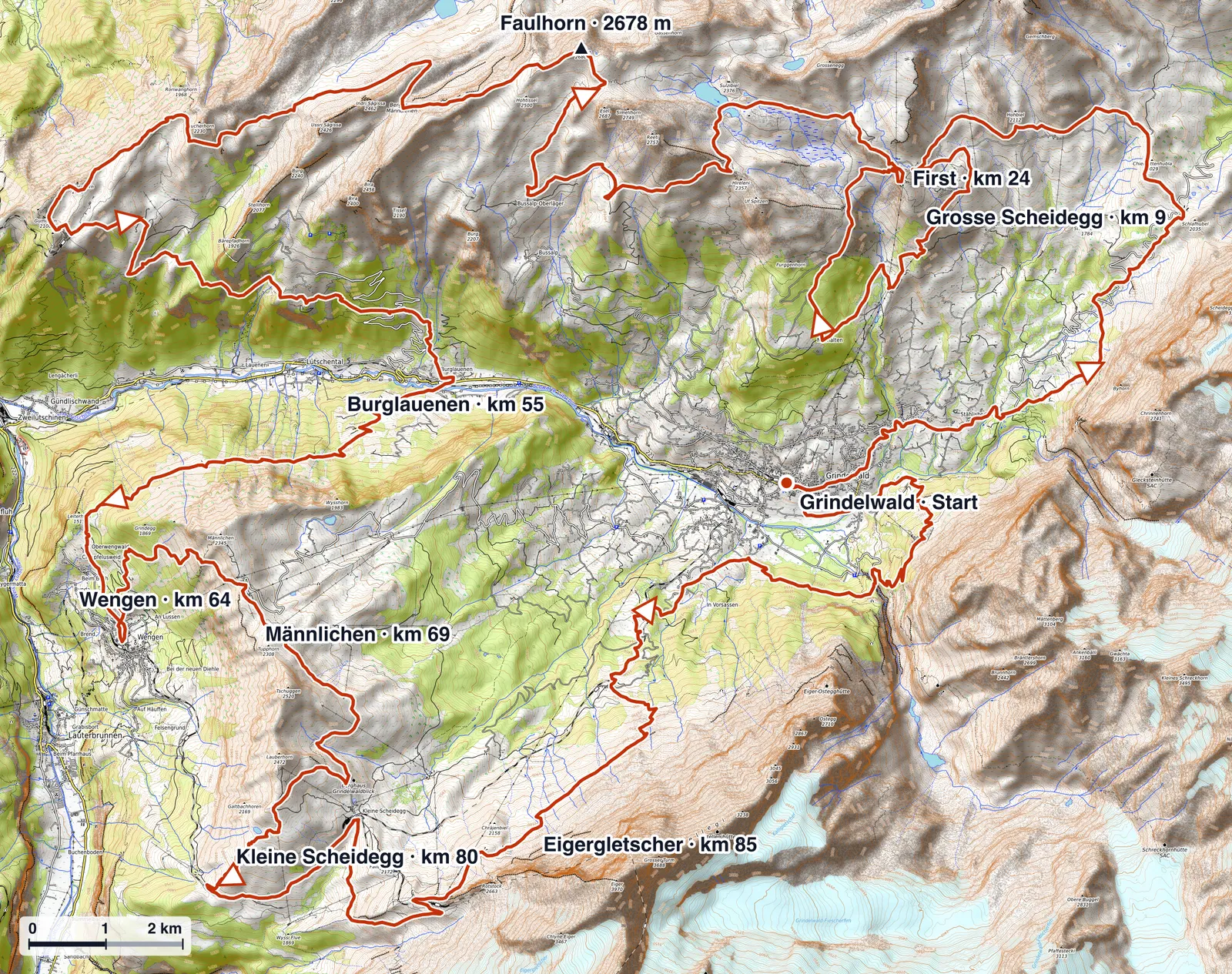
Topographic map of the Eiger Ultra Trail E101 course: a loop around the Eiger massif with start and finish in Grindelwald, direction arrows, the main aid stations labelled with official kilometres and the high point at the Faulhorn (2,678 m)
The E101 loop on the topographic map: the dot marks start and finish in Grindelwald, white arrows show the direction of travel, labels mark the main aid stations with official kilometres, the triangle marks the high point of the course at the Faulhorn (about 2,678 m). Map data: © OpenStreetMap contributors, SRTM · map style: © OpenTopoMap (CC-BY-SA)

Based on public sources and the official GPX file. Last updated on 12 June 2026.

E101 starts and finishes in Grindelwald at around 1,034 m. The loop circles the Eiger massif through the classic Bernese Oberland. The highest point is approximately 2,678 m, the lowest around 891 m.

Course character

E101 is not an evenly runnable 100 km loop. Long climbs, technically demanding descents and several exposed passages above 2,000 m alternate with faster valley sections. The decisive load comes in the second half: after the low point at Burglauenen, the climbs towards Wengen and Männlichen arrive on already tired legs. The profile therefore rewards a controlled start more than aggressive pacing over the opening kilometres.

Four acts, not one even loop

It helps to read E101 as four distinct acts rather than a single 100 km run.

  1. Night start and the first 1,000 m. From Grindelwald the course climbs almost from the start line to Grosse Scheidegg. The bunched field and the 04:00 darkness make it easy to start too hard.
  2. The high route around First and Faulhorn. After the descent to Bort the course climbs back into open, exposed terrain around First, the high point near the Faulhorn (about 2,678 m) and the long traverse towards Schwand, usually already in full sun.
  3. The technical middle to Burglauenen and Wengen. A long descent to the low point near Burglauenen, then the climb out of the valley to Wengen. This is where heat and accumulated fatigue first bite.
  4. The alpine finish. The steep climb to Männlichen, the passage near Kleine Scheidegg below the Eiger north face, the long night descent to Brandegg and a final sting up to Pfingstegg before Grindelwald.

Key climbs and descents

Read from the official checkpoint profile, the decisive efforts are concentrated and steep rather than spread evenly:

  • Grindelwald → Grosse Scheideggkm 0–9
    +990 m112 m/km
  • Bort → Firstkm 18–24
    +630 m113 m/km
  • Burglauenen → Wengenkm 55–64
    +770 m86 m/km
  • Wengen → Männlichensteepestkm 64–69
    +945 m193 m/km
Accent = the day's steepest climb, almost twice as steep as the start. Bars: elevation gain from the official checkpoint data.

The hardest descent mirrors them: Kleine Scheidegg to Brandegg drops roughly 1,170 m against about +465 m of counter-climbs, a long night descent that punishes quads and feet far more than the distance suggests. The pattern is consistent: E101 hides its difficulty in steepness and in where the climbs fall, not in raw altitude.

Terrain and surface

E101 is not one uniform surface. Most of the route follows narrow Swiss mountain trails (white-red-white), often steep, stony and in places exposed. Faster gravel and service roads appear on some descents and approaches, there is short tarmac through the villages and at start and finish, and the closing kilometres under the Eiger north face mix steep grassy slopes, streams and mountain path. The useful summary is a technical mountain trail with stony, exposed sections threaded through premium Jungfrau-region infrastructure, rather than long classic scree.

GPX download

The GPX download is available on the E101 race page.

Tactics

Eiger Ultra Trail E101 Cut-offs and Intermediate Times 2026

Time limit 25 hours, start at 04:00 in Grindelwald and intermediate times for the key checkpoints.

The time limit at E101 is 25 hours. Start is at 04:00 in Grindelwald; the intermediate times are listed in the table.

Cut-off times and checkpoints

StationkmD+D-2026 cut-off
Start0.00 m0 m04:00
Grosse Scheidegg8.8990 m65 m06:30
Bort18.21,220 m690 m08:00
First (2nd passage)23.81,850 m720 m09:30
Feld30.22,150 m1,050 m11:00
Faulhorn35.212:30
Egg40.72,845 m1,740 mNo cut-off
Schwand48.53,025 m2,490 m15:30
Burglauenen55.43,270 m3,395 m17:00
Wengen64.44,040 m3,785 m19:30
Männlichen69.34,985 m3,785 m21:30
Kleine Scheidegg79.75,400 m4,380 m23:45
Eigergletscher85.000:45
Brandegg90.95,865 m5,550 m02:30
Pfingstegg97.36,365 m6,005 m04:15
Finish101.66,440 m6,440 m05:00

Data: Eiger by UTMB 2026. Runners must leave the station before the listed time.

Where time is lost at E101

With 6,700 m D+ on 101 km, E101 is significantly steeper than a linear profile suggests. The second half costs more time per kilometre than the first. Planning cut-offs only linearly underestimates cumulative fatigue on exposed sections after km 60.

Pacing the 25-hour limit

The first cut-off gives 2.5 hours for 8.8 km and 990 m of climb to Grosse Scheidegg. That is not an invitation to race the cut-off, it is a signal that the field goes uphill immediately. The strategy that holds up on E101 is conservative-aggressive: very calm for the first 25 to 30 km, neutral through the high section around the Faulhorn, and only offensive once the climb into Wengen feels controlled.

A realistic finish-time orientation

With 6,700 m of climb under a 25-hour limit, finish times spread widely. As a rough orientation, not a guarantee:

  • Elite1114 h
  • Strong amateur1619 h
  • Mid-pack2021 h
  • Back of field2224 h
  • Cut-off fight2425 h

Self-support, drop bag and support points

E101 runs on partial self-support: you should be able to cover food and fluid between stations on your own, with the aid stations as help rather than a safety net. Two details matter tactically. Burglauenen, around km 55, is the main aid station and the drop-bag point, with warm pasta and salted potatoes, the natural place to change a shirt and reset before the second half. High up, Egg is a water-only point and Faulhorn is a reduced high-mountain station, so do not count on a full restock there. Support is allowed only in designated zones, but the Jungfrau-region transport makes many of them easy to reach: Grosse Scheidegg, Bort, First, Wengen, Männlichen, Kleine Scheidegg, Brandegg and Pfingstegg.

Aid stations

Aid stations at the Eiger Ultra Trail E101

The 2026 supply plan arranged along the course: select a station to check drinks, sports nutrition, warm food and snacks.

02 / 15km 8.8

Basic supply

Grosse Scheidegg

Cut-off06:30

Drinks

  • Water
  • Naak Boost Energy Drink Mix
  • Bottle refill Naak Boost Energy Drink Mix

Sports nutrition

  • Naak Boost Gel

Fruit & snacks

  • Müsli Cookie Apple
  • Müsli Cookie Salty
  • Bananas
  • Cake
  • Chips
All stations as a list
  1. Startkm 0.0Start supply

    Drinks: Water, Naak Boost Energy Drink Mix, Bottle refill Naak Boost Energy Drink Mix

  2. Grosse Scheideggkm 8.8Basic supply

    Drinks: Water, Naak Boost Energy Drink Mix, Bottle refill Naak Boost Energy Drink Mix

    Sports nutrition: Naak Boost Gel

    Fruit & snacks: Müsli Cookie Apple, Müsli Cookie Salty, Bananas, Cake, Chips

  3. Bortkm 18.2Basic supply

    Drinks: Water, Naak Boost Energy Drink Mix, Bottle refill Naak Boost Energy Drink Mix

    Fruit & snacks: Müsli Cookie Apple, Müsli Cookie Salty, Bananas

  4. First (2nd passage)km 23.8Warm food

    Drinks: Water, Naak Boost Energy Drink Mix, Bottle refill Naak Boost Energy Drink Mix, Warm tea, Coffee, Vegetarian bouillon

    Sports nutrition: Naak Boost Gel, Naak Energy Bar, Naak Energy Waffel

    Warm & savoury: Warm soupe vegi

    Fruit & snacks: Müsli Cookie Apple, Müsli Cookie Salty, Bread, Bananas, Oranges, Local cheese, Dried meat, Cake, Dry fruits, Nuts, Chips, Chocolate

  5. Feldkm 30.2Warm food

    Drinks: Water, Naak Boost Energy Drink Mix, Bottle refill Naak Boost Energy Drink Mix, Warm tea, Coffee, Vegetarian bouillon

    Sports nutrition: Naak Boost Gel

    Fruit & snacks: Müsli Cookie Apple, Müsli Cookie Salty, Bread, Bananas, Oranges, Local cheese, Dried meat, Cake, Dry fruits, Nuts, Chips, Chocolate

  6. Faulhornkm 35.2Basic supply

    Drinks: Water, Naak Boost Energy Drink Mix, Coca Cola, Vegetarian bouillon

    Fruit & snacks: Müsli Cookie Apple, Müsli Cookie Salty, Bread, Cake, Chips

  7. Eggkm 40.7Water only

    Drinks: Water

  8. Schwandkm 48.5Warm food

    Drinks: Water, Naak Boost Energy Drink Mix, Bottle refill Naak Boost Energy Drink Mix, Warm tea, Coffee, Coca Cola, Vegetarian bouillon

    Sports nutrition: Naak Boost Gel, Naak Energy Bar, Naak Energy Waffel

    Fruit & snacks: Müsli Cookie Apple, Müsli Cookie Salty, Bread, Bananas, Oranges, Local cheese, Dried meat, Cake, Dry fruits, Nuts, Chips, Chocolate

  9. Burglauenenkm 55.4Warm food

    Drinks: Water, Naak Boost Energy Drink Mix, Bottle refill Naak Boost Energy Drink Mix, Warm tea, Coffee, Coca Cola, Vegetarian bouillon

    Sports nutrition: Naak Boost Gel, Naak Energy Bar, Naak Energy Waffel

    Warm & savoury: Pasta nature, Cooked potatoes

    Fruit & snacks: Müsli Cookie Apple, Müsli Cookie Salty, Bread, Bananas, Oranges, Local cheese, Dried meat, Cake, Dry fruits, Nuts, Chips, Chocolate, Melons

  10. Wengenkm 64.4Basic supply

    Drinks: Water, Naak Boost Energy Drink Mix, Bottle refill Naak Boost Energy Drink Mix, Coca Cola, Vegetarian bouillon

    Fruit & snacks: Müsli Cookie Apple, Müsli Cookie Salty, Bread, Chips, Chocolate

  11. Männlichenkm 69.3Warm food

    Drinks: Water, Naak Boost Energy Drink Mix, Bottle refill Naak Boost Energy Drink Mix, Warm tea, Coffee, Coca Cola, Vegetarian bouillon

    Sports nutrition: Naak Boost Gel, Naak Energy Bar, Naak Energy Waffel

    Warm & savoury: Warm soupe vegi

    Fruit & snacks: Müsli Cookie Apple, Müsli Cookie Salty, Bread, Bananas, Oranges, Local cheese, Dried meat, Cake, Dry fruits, Nuts, Chips, Chocolate

  12. Kleine Scheideggkm 79.7Basic supply

    Drinks: Water, Naak Boost Energy Drink Mix, Bottle refill Naak Boost Energy Drink Mix, Warm tea, Coffee, Coca Cola, Vegetarian bouillon

    Sports nutrition: Naak Boost Gel

    Fruit & snacks: Müsli Cookie Apple, Müsli Cookie Salty, Bread, Bananas, Chips, Chocolate

  13. Brandeggkm 90.9Warm food

    Drinks: Water, Naak Boost Energy Drink Mix, Bottle refill Naak Boost Energy Drink Mix, Warm tea, Coffee, Coca Cola, Vegetarian bouillon

    Sports nutrition: Naak Boost Gel, Naak Energy Bar, Naak Energy Waffel

    Warm & savoury: Warm soupe vegi

    Fruit & snacks: Müsli Cookie Apple, Müsli Cookie Salty, Bread, Bananas, Oranges, Local cheese, Dried meat, Cake, Dry fruits, Nuts, Chips, Chocolate

  14. Pfingsteggkm 97.3Basic supply

    Drinks: Water, Naak Boost Energy Drink Mix, Bottle refill Naak Boost Energy Drink Mix, Warm tea, Coffee, Coca Cola, Vegetarian bouillon

    Fruit & snacks: Müsli Cookie Apple, Müsli Cookie Salty, Bread, Bananas, Dry fruits, Nuts, Chips, Chocolate

  15. Finishkm 101.6Finish supply

    Drinks: Water, Naak Boost Energy Drink Mix, Coca Cola

    Fruit & snacks: Bananas, Oranges

Source: Eiger by UTMB 2026 supply plan. On-site availability can change.

Gear check

Eiger Ultra Trail E101 Mandatory Kit 2026

The E101 mandatory kit explained through alpine logic: what gets checked, what counts in the race and which items are regularly underestimated.

The mandatory kit translates alpine terrain, July heat and thunderstorm risk into enforceable rules. This overview follows the E101 | 100K list; the current version on the E101 race page applies on race day.

Complete E101 Mandatory Kit

Pack and Navigation

  • Trail running backpack to carry mandatory kit throughout the entire race.
  • Smartphone with international roaming that works in Switzerland. The runner must be reachable at all times before, during and after the race. Emergency numbers from the organiser must be saved. The emergency number must not be blocked. Start with a fully charged battery. Flight mode is forbidden. LiveRun app must be installed. Recommendation: carry a spare battery pack.

Water and Nutrition

  • Personal collapsible cup, minimum 15 cl / 5 oz. Flasks with lids are not accepted.
  • Minimum 1 litre of water.
  • Food: 800 kcal recommended (e.g. 2 gels + 2 bars).

Light

  • Two working headlamps with spare batteries or spare battery pack for each headlamp. A powerbank instead of a spare battery pack is allowed. Recommendation: at least 200 lumens for the main headlamp.

Safety

  • Emergency blanket at least 1.40 m × 2 m (55" × 80").
  • Whistle.
  • Self-adhesive elastic bandage for wrapping or binding, minimum 100 × 6 cm / 40 × 2.5 inches.

Clothing

  • Waterproof mountain jacket with hood: The jacket must be made from a waterproof and breathable membrane. Minimum 20,000 mm water column recommended. RET value recommended: at least 13. The hood must be integrated or attached using the manufacturer's intended system. Seams must be sealed. No non-waterproof fabric sections. Manufacturer-fitted ventilation (underarm, back) is accepted.
  • Full leg coverage: Long trousers OR a combination of leggings and socks OR shorts and leg sleeves to cover the legs completely.
  • Cap, bandana or Buff.
  • Warm long-sleeve top (not cotton), minimum 180 g (6.5 oz) OR the combination of a warm long-sleeve shirt (not cotton, minimum 110 g / 4 oz) with a wind jacket with water-resistant protection. The wind jacket does not replace the rain jacket and vice versa. The combination of arm sleeves and a T-shirt is not accepted.
  • Sunglasses.

What is often underestimated at E101

Compared to many other ultras, two points are particularly critical at E101:

  1. The jacket requirement is serious. 20,000 mm water column and sealed seams are alpine standards, not bureaucratic numbers. An ultralight 40 g model almost never meets these requirements. A reliable model weighs 150 to 250 g.

  2. Two separate headlamps, not one with spare batteries. The requirement specifies two working headlamps. A dead lamp with fresh batteries does not count as a backup. Test both lamps 48 hours before the start.

  3. The collapsible cup is mandatory, not a flask with a lid. This is not a detail, it counts at the aid station when organisers check for the cup.

  4. The phone must be reachable. Flight mode and do-not-disturb risk disqualification, not just a warning. LiveRun must be installed and open.

Packing logic for E101

E101 has one drop bag: you hand it in at the start area, the organiser carries it to the Burglauenen aid station at around km 55 and afterwards to the finish in Grindelwald. Plan a reset there (dry shirt, restock, batteries), but carry the full mandatory kit the entire loop. Typical zones in the pack:

  • Main compartment or back section: Rain jacket, warm long-sleeve top, leg sleeves / long trousers, emergency blanket, elastic bandage.
  • Chest pockets: Softflasks, collapsible cup, snacks, whistle, phone.
  • Side pockets or hip belt: Main headlamp (when not on head), backup headlamp, spare batteries / powerbank.
  • Easily accessible: Sunglasses, cap / Buff, sunscreen for early valley sections.
Weather

Eiger Ultra Trail E101 Weather 2026: Conditions on the Course

Typical July conditions in the Bernese Oberland, organised by elevation zone and race phase.

E101 takes place in mid-July, when the Bernese Oberland shows the most typical alpine summer weather dynamics: hot valley sections in Grindelwald, cold passages on exposed ridges above 2,000 m, and a thunderstorm risk that becomes relevant from early afternoon.

Weather phases on the E101 course

The elevation profile links valley heat, long exposed passages and a possible second temperature drop after dark. The useful question is therefore not only the forecast for Grindelwald, but how conditions change along the course.

  1. 01

    km 0–18 · Grindelwald to Bort

    Early start, rapid elevation gain

    Cool valley air followed by a quick transition to wind and stronger UV exposure.

    Decision: Keep a light warm layer accessible and apply sun protection before the first long climb.

  2. 02

    km 18–41 · high route to Egg

    Long exposure above 2,000 m

    The coldest and most wind-exposed part of the loop, with no forest cover during weather changes.

    Decision: Do not bury the waterproof jacket. React early to race-control instructions when the sky deteriorates.

  3. 03

    km 41–69 · valley floor to Männlichen

    Valley heat, storm risk above

    Temperatures can rise sharply after the low point while the next climb returns to exposed terrain.

    Decision: Cool and drink deliberately in the valley, then reassess the weather and station notices before climbing.

  4. 04

    km 69–101 · return to Grindelwald

    Second high phase and possible night

    More altitude, long descents and falling temperatures after sunset for slower runners.

    Decision: Prepare a dry layer and headlamp before darkness rather than after visibility and dexterity decline.

The biggest risk on a "nice" day is the heat

Counterintuitively, a clear July forecast is its own hazard. The exposed slopes before the Faulhorn and the climb into Wengen and Männlichen sit in full sun with little shade, and valley sections near Grindelwald can reach 25 to 35 °C. Active cooling, electrolytes and a cap or buff matter as much here as the rain jacket. Higher up and after dark the opposite applies: even after a hot day the ridges can turn very cold, which hits slower runners hardest in the second half.

Snow and the high route earlier in the season

The original trails open progressively from mid-June depending on snow and melt, and the organiser only starts course recces from late June. By race weekend in mid-July the high route is normally clear, but lingering snow patches, wet ground and soft footing on the exposed sections above 2,000 m are not unusual after a cold spring.

Preparation

Eiger Ultra Trail E101 Checklist 2026

The last 14 days before the 18 July start, organised by taper, race week, final days and race day.

The final two weeks are no longer about building fitness. They are about removing open decisions: lock the equipment system, follow organiser communications and arrive on race morning with a routine already tested.

The four phases before the start

  1. 14–8days

    Lock the system

    • Complete the final longer session
    • Finalise shoes, pack and poles
    • Confirm travel and accommodation
  2. 7–4days

    Full equipment check

    • Check the current mandatory list item by item
    • Test LiveRun, roaming and offline GPX
    • Portion nutrition by aid station
  3. 3–1days

    Secure the details

    • Check organiser messages and weather daily
    • Test both lamps and every spare
    • Pack in order of access
  4. 04:00start

    Race morning

    • Read final route and cut-off changes
    • Fully charge the phone
    • Keep cup, water and weather layer accessible
Common questions

Questions about the Eiger Ultra Trail E101

When does the Eiger Ultra Trail E101 2026 take place?

E101 takes place on 18 July 2026. The start is at 04:00 in Grindelwald. The time limit is 25 hours.

What is the distance and elevation profile of E101?

E101 is listed at 101.6 km with around 6,700 m of elevation gain. The lowest point is around 891 m, the highest around 2,678 m.

What mandatory kit is required at E101?

Required items include: trail running backpack, smartphone with LiveRun and international roaming, collapsible cup (no flask lids), at least 1 litre of water, two working headlamps with spare batteries, emergency blanket (140×200 cm), whistle, elastic bandage, 800 kcal food, waterproof jacket with hood (20,000 mm, sealed seams), full leg coverage, cap/buff, warm long-sleeve top (min. 180 g, not cotton) and sunglasses.

Is the Eiger Ultra Trail part of the UTMB World Series?

Yes, the Eiger Ultra Trail is a UTMB World Series event. The race takes place in Grindelwald, Switzerland and counts as a qualifying race for UTMB Mont-Blanc.

Does E101 have a drop bag, and where can supporters watch?

Yes. E101 has one drop bag: you hand it in at the start area, the organiser transports it to the Burglauenen aid station at around km 55 and afterwards to the finish in Grindelwald. Supporters are allowed at eight refreshment points reachable by cable car, bus or train: Grosse Scheidegg, Bort, First, Wengen, Männlichen, Kleine Scheidegg, Brandegg and Pfingstegg.

Is the Eiger Ultra Trail a typical alpine race?

Yes, very much, with a Swiss signature. It has long steep climbs, exposure to weather, sections above 2,000 m, technical descents and mandatory layers, but it is not extreme high-altitude and it is unusually well supported: the dense Jungfrau-region transport lets spectators reach most stations. Expect a steep, rhythmically changing 100 km rather than a smooth, evenly runnable one.

How long is E101 exactly?

The organiser lists 101.6 km. The GPX analysis gives around 99-100 km; the difference comes from smoothing and measurement tolerances.

Which are the hardest climbs on E101?

The steepest efforts are the start climb to Grosse Scheidegg (about +990 m over 8.8 km) and, above all, Wengen to Männlichen (about +945 m over 4.9 km) after 64 km of racing. Burglauenen to Wengen (about +770 m over 9 km) and the long night descent from Kleine Scheidegg to Brandegg are the other decisive sections.

What is the time limit at E101?

The time limit at E101 is 25 hours. The start is at 04:00 in Grindelwald. That means finish closure at 05:00 the following day.

What is a realistic finish time for E101?

As a rough orientation under the 25-hour limit: elite and sub-elite around 11 to 14 hours, a strong alpine amateur around 16 to 19 hours, a mid-pack finisher around 20 to 21 hours, and the back of the field around 22 to 25 hours. With 6,700 m of climb the second half is much slower than the first, so plan your buffer accordingly.

Which rain jacket meets the E101 requirements?

The jacket needs at least 20,000 mm water column, sealed seams and an integrated or attached hood. Ultralight models under 100 g rarely meet these requirements. Reliable models for alpine ultra races typically weigh 150-250 g.

Why are two headlamps required?

E101 starts in the early morning and for slower runners can extend into the night. Two separate working lamps are mandatory. A dead lamp with fresh batteries does not count as a second lamp. Both must work throughout the race.

Why a collapsible cup instead of a flask with a lid?

Aid stations at UTMB races pour drinks into open containers brought by runners. A collapsible cup without a lid is required to receive drinks at the station. Softflasks with drinking valves are not accepted for this purpose.

How hot does it get at E101 in July?

In the valley near Grindelwald, temperatures of 25-35 °C are possible in July. On exposed ridges above 2,000 m it can be 4-10 °C. The transition happens within a few hours.

Can the E101 course be changed because of weather?

Yes. The organiser can change or shorten the course at short notice, or stop the race, for example in case of thunderstorms, strong winds or other safety risks. Check Eiger Ultra Trail by UTMB communications the day before and again on race morning, keep your smartphone switched on, and do not plan exclusively around a previously saved route or cut-off table.

What must be done the day before E101?

Pack complete and closed. Both headlamps tested. Phone fully charged with LiveRun installed. Emergency numbers saved. Collapsible cup checked. All mandatory kit present.

Newsletter

Science-backed notes on training, recovery, and racing smarter in the mountains

Join the newsletter and get thoughtful new writing when it's published. No noise, just useful notes for mountain runners.

More race hubs