ENDURING MOTION
The Tre Cime di Lavaredo in the Dolomites, the high point of the Lavaredo 120K course
Race Hub · 2026

Lavaredo 120K 2026: Course & Strategy

This page brings the publicly available information for the Lavaredo 120K 2026 into one place, organised by the questions that matter before the start: course, cut-offs, mandatory kit, weather and the final two weeks of preparation.

Distance120 km
Elevation gain5,800 m D+
Start26 June 2026, 23:00
Time limit30 hours
Elevation profile

Course · 120 km · 5,800 m D+

One loop from Cortina d’Ampezzo (1,210 m) with a night start at 23:00 and sunrise at the Tre Cime di Lavaredo. Move the cursor (or use the arrow keys ←/→) across the profile to reveal distance, elevation and the next checkpoint with its cut-off.

steep climbclimbrollingdescent
drop bagwater onlycut-off

Lavaredo 120K GPX analysis: 120.2 km and roughly 5,500 m D+. Organiser figures: 120 km and 5,800 m D+.

Three key segments, read from the GPX data
  1. 01

    Night start · first half to the high point

    km 0 – 52·+2,810 m climb·Cortina 1,210 m → Forcella Lavaredo 2,456 m

    The start falls at 23:00 in the dark. Most of the early climbing stacks up on the way to the high point at Forcella Lavaredo. Running too fast here in the night gets repaid far more expensively in the second half.

  2. 02

    Tre Cime at first light · then the long descent

    high point 2,456 m at km 52·−950 m to Cimabanche·mid-race low point 1,521 m

    Sunrise at the Tre Cime di Lavaredo is the narrative peak of the race, but it arrives together with cold and exposed terrain. A long descent then drops to the Cimabanche life base at km 67.

  3. 03

    Decisive second half · on tired legs

    km 67 – 120·+2,590 m climb from Cimabanche·longest climbing Malga Ra Stua → Rifugio Averau 2,417 m

    From Cimabanche the decisive climbing arrives on already tired legs: the ascent via Malga Travenanzes and Col Gallina to Rifugio Averau and on to Passo Giau. Only after that does the course drop back to Cortina.

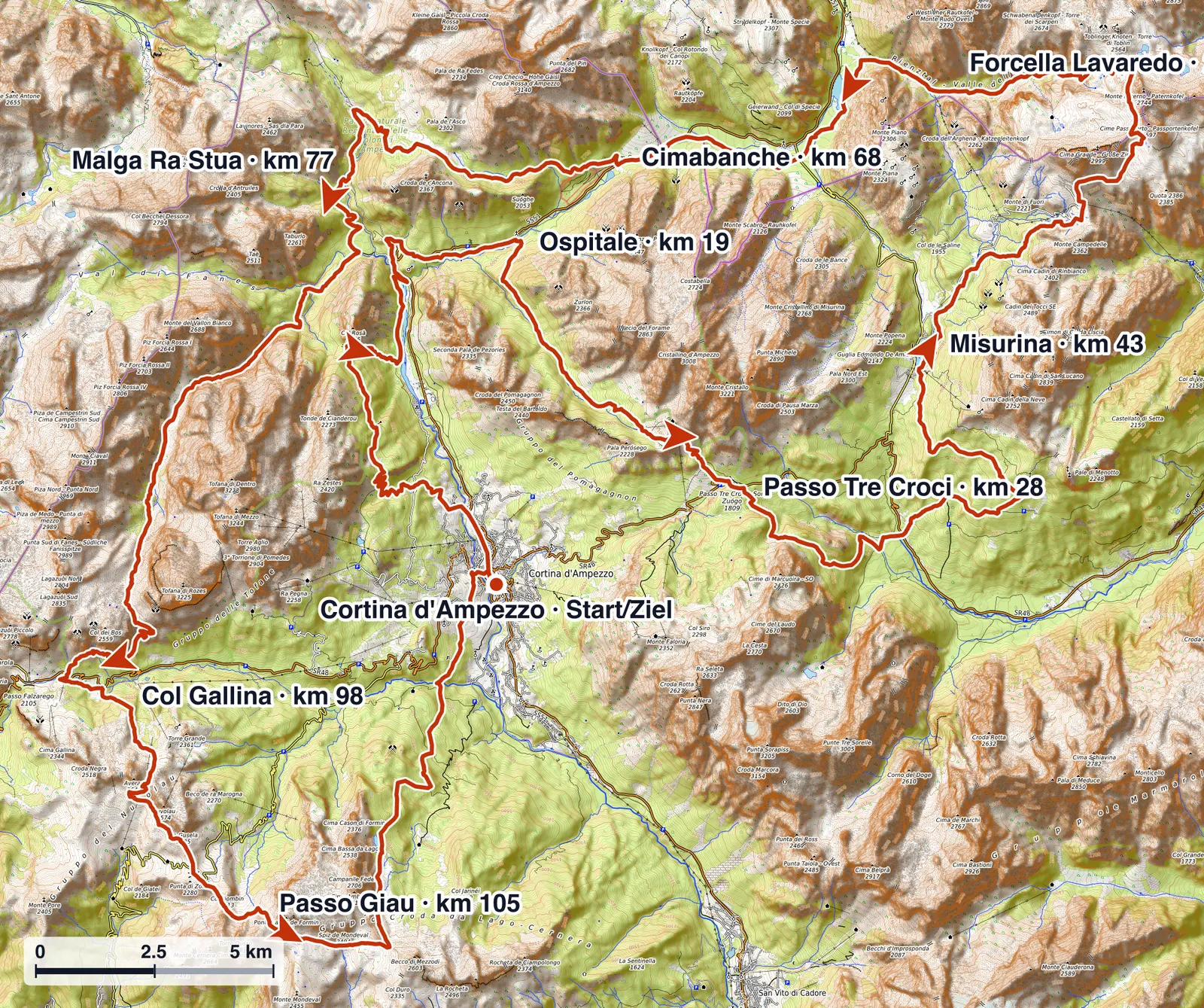
Topographic map of the Lavaredo 120K course: a loop in the Dolomites with start and finish in Cortina d'Ampezzo, direction arrows, the main aid stations labelled with official kilometres and the high point at Forcella Lavaredo (2,456 m)
The 120K loop on the topographic map: the dot marks start and finish in Cortina d'Ampezzo, white arrows show the direction of travel, labels mark the main aid stations with official kilometres, the triangle marks the high point of the course at Forcella Lavaredo (about 2,456 m). Map data: © OpenStreetMap contributors, SRTM · map style: © OpenTopoMap (CC-BY-SA)

Based on public sources and the official GPX file. Last updated on 15 June 2026.

The Lavaredo 120K starts and finishes in Cortina d'Ampezzo at around 1,210 m. The loop circles the eastern Dolomites, with the high point at Forcella Lavaredo (about 2,456 m) reached at sunrise below the Tre Cime di Lavaredo.

Course character

The 120K is the queen race of the Lavaredo Ultra Trail: long climbs and technical descents on Dolomite terrain, broken by faster valley sections. The defining feature is the 23:00 night start, which puts the first half and the high point at the Tre Cime in darkness and dawn. The decisive load comes in the second half: after the Cimabanche life base at km 67, the climbing towards Col Gallina, Rifugio Averau and Passo Giau stacks up on tired legs. The profile rewards a controlled night more than aggressive pacing over the opening kilometres.

Four acts, not one even loop

It helps to read the 120K as four distinct acts rather than a single 120 km run.

  1. Night start in the valley. From Cortina the course works through the dark to Ospitale and the first hard cut-off at Passo Tre Croci. The fresh legs and the night make it easy to start too hard.
  2. The Tre Cime high point at first light. The climb past Misurina and Rifugio Auronzo to Forcella Lavaredo (about 2,456 m) reaches the high point of the course at sunrise, usually with cold and exposure, before the long descent to the Cimabanche life base.
  3. The decisive second half. From Cimabanche the climbing stacks back up on tired legs: Malga Ra Stua, the long pull through Malga Travenanzes to Col Gallina, then the steep wall to Rifugio Averau and on to Passo Giau.
  4. The final ridge to Cortina. From Passo Giau the course runs past Rifugio Croda da Lago and drops back down into Cortina for the finish in the Olympic Ice Stadium.

Key climbs and descents

Read from the official checkpoint profile, the decisive efforts are concentrated rather than spread evenly:

  • Ospitale → Passo Tre Crocikm 18.7–28
    +657 m71 m/km
  • Misurina → Forcella Lavaredokm 42.6–52.5
    +749 m76 m/km
  • Cimabanche → Malga Ra Stuakm 67.5–77.1
    +533 m56 m/km
  • Col Gallina → Rifugio Averausteepestkm 97.7–101.9
    +470 m112 m/km
Accent = the day's steepest climb, the short wall up to Rifugio Averau on tired legs. Bars: elevation gain from the official checkpoint data.

The pattern is consistent: the 120K front-loads the high point at the Tre Cime and back-loads the steepest climbing. The short wall from Col Gallina to Rifugio Averau is the steepest pitch of the day and it falls past km 97, when legs and a possible second night are already working against you.

Terrain and surface

The 120K is Dolomite mountain terrain rather than a runnable forest ultra. The first half is deceptively friendly: wide gravel and old military roads, forest paths and longer flowing descents let you move well, with only the narrow switchbacks and the climb to the Tre Cime hinting at what is coming. The cost arrives in the second half, and it is muscular more than vertical.

The stony descent off the Tre Cime works feet and quads hard, the valley after Malga Ra Stua and Malga Travenanzes mixes loose limestone, roots and stream crossings, and the closing kilometres add rocky, rooted trail before a long descent from Rifugio Croda da Lago that ends legs more than it ends the clock. There is short tarmac through Misurina and at start and finish in Cortina. The useful summary is a technical Dolomite mountain trail whose difficulty is back-loaded into loose, rocky descents, rather than concentrated in one steep wall.

A small alpine lake below jagged Dolomite peaks with green slopes and a trail

Navigation and markings

The course is marked with reflective way markers that catch a headlamp beam, so the night sections stay navigable as long as you keep markers in sight. The organiser uses no paint on the trails, and the regulation is explicit: if you can no longer see way markers, turn back. Navigation is rarely the problem in daylight with a full field, but it gets harder on the lonely, technical second half at night and in fog, where tired runners miss sudden turns. The first narrow singletrack after the fast start is also a known congestion point, so expect to queue early rather than force the pace.

GPX download

The GPX download is available on the Lavaredo 120K race page.

Tactics

Lavaredo 120K Cut-offs and Intermediate Times 2026

Time limit 30 hours, night start at 23:00 in Cortina and intermediate times for the key checkpoints.

The time limit at the Lavaredo 120K is 30 hours. The start is at 23:00 in Cortina d'Ampezzo; the intermediate times are listed in the table below.

Cut-off times and checkpoints

StationkmD+D-2026 cut-off
Start0.00 m0 m23:00
Ospitale18.7819 m547 mNo cut-off
Passo Tre Croci28.01,476 m890 m04:30
Federavecchia34.01,539 m1,365 mNo cut-off
Misurina42.62,106 m1,554 m08:00
Rifugio Auronzo (water)49.82,696 m1,598 mNo cut-off
Forcella Lavaredo52.52,855 m1,611 mNo cut-off
Cimabanche (life base)67.52,980 m2,660 m13:30
Malga Ra Stua77.13,513 m3,018 m15:30
Malga Travenanzes (water)90.54,290 m3,518 mNo cut-off
Rifugio Col Gallina97.74,786 m3,938 m21:30
Rifugio Averau (medical)101.95,256 m4,052 mNo cut-off
Passo Giau105.35,364 m4,329 m23:59
Rifugio Croda da Lago112.95,671 m4,828 mNo cut-off
Finish120.05,800 m5,800 m05:00

Data: Lavaredo Ultra Trail 2026 official timing table. Start Friday 23:00; the intermediate cut-offs fall on Saturday, and the finish in Cortina closes Sunday at 05:00 (30 h). Runners must leave the station before the listed time.

Where time is lost at the Lavaredo 120K

With 5,800 m D+ over 120 km and a 23:00 start, the Lavaredo 120K front-loads the high point and back-loads the climbing. The first hard cut-off comes early at Passo Tre Croci (km 28, 04:30). After the Cimabanche life base at km 67, the second half costs more time per kilometre than a linear plan suggests: Col Gallina (km 98, 21:30) and Passo Giau (km 105, 23:59) close late in the day, when fatigue and a possible second nightfall slow exposed sections.

Pacing the 30-hour limit

The early cut-offs are not an invitation to race them, they are a signal that the high point at the Tre Cime comes in the dark on fresh legs and that the climbing waits in the second half. The strategy that holds up over 120 km is conservative-aggressive: very calm through the night to Forcella Lavaredo, neutral on the long descent to Cimabanche, and only offensive once the climb out of the life base feels controlled.

A realistic finish-time orientation

With 5,800 m of climb under a 30-hour limit, finish times spread widely. As a rough orientation, not a guarantee:

  • Elite1315 h
  • Strong amateur1822 h
  • Mid-pack2326 h
  • Back of field2729 h
  • Cut-off fight2930 h

Self-support, drop bag and support points

The 120K runs on partial self-support: you should be able to cover food and fluid between stations on your own, with the aid stations as help rather than a safety net. Two details matter tactically. Cimabanche, at km 67, is the life base and the drop-bag point, with warm broth, soup and pasta, the natural place to change a shirt and reset before the second half. High up, Rifugio Auronzo and Malga Travenanzes are water-only points, so do not count on a full restock there. Warm food returns later at Col Gallina and Passo Giau. Personal support from a crew is allowed only at Cimabanche and Col Gallina, and only inside the marked zone.

Aid stations

Aid stations at the Lavaredo 120K

Eight aid stations and two water points along the course. Select a station to check what typically waits there: drinks, warm options and snacks.

06 / 12km 67.5

Life base

Cimabanche (life base)

Cut-off13:30

Drinks

  • Water
  • Sports drink
  • Tea
  • Coffee
  • Cola

Warm & savoury

  • Broth
  • Soup
  • Pasta

Fruit & snacks

  • Fruit
  • Bread
  • Cheese
  • Cured meat
  • Biscuits
  • Dried fruit
  • Chocolate
All stations as a list
  1. Startkm 0.0Start area

    Drinks: Water, Sports drink, Tea

    Fruit & snacks: Fruit, Biscuits

  2. Ospitalekm 18.7Aid station

    Drinks: Water, Sports drink, Tea, Cola

    Fruit & snacks: Fruit, Bread, Biscuits, Dried fruit, Chocolate

  3. Passo Tre Crocikm 28.0Aid station

    Drinks: Water, Sports drink, Tea, Cola

    Fruit & snacks: Fruit, Bread, Biscuits, Dried fruit, Chocolate

  4. Misurinakm 42.6Aid station

    Drinks: Water, Sports drink, Tea, Cola

    Fruit & snacks: Fruit, Bread, Biscuits, Dried fruit, Chocolate

  5. Rifugio Auronzo (water)km 49.8Water only

    Drinks: Water

  6. Cimabanche (life base)km 67.5Life base

    Drinks: Water, Sports drink, Tea, Coffee, Cola

    Warm & savoury: Broth, Soup, Pasta

    Fruit & snacks: Fruit, Bread, Cheese, Cured meat, Biscuits, Dried fruit, Chocolate

  7. Malga Ra Stuakm 77.1Aid station

    Drinks: Water, Sports drink, Tea, Cola

    Fruit & snacks: Fruit, Bread, Cheese, Biscuits, Dried fruit, Chocolate

  8. Malga Travenanzes (water)km 90.5Water only

    Drinks: Water

  9. Rifugio Col Gallinakm 97.7Warm food

    Drinks: Water, Sports drink, Tea, Coffee, Cola

    Warm & savoury: Broth, Soup

    Fruit & snacks: Fruit, Bread, Cheese, Biscuits, Dried fruit, Chocolate

  10. Passo Giaukm 105.3Warm food

    Drinks: Water, Sports drink, Tea, Coffee, Cola

    Warm & savoury: Broth, Soup

    Fruit & snacks: Fruit, Bread, Cheese, Biscuits, Dried fruit, Chocolate

  11. Rifugio Croda da Lagokm 112.9Aid station

    Drinks: Water, Sports drink, Tea, Cola

    Fruit & snacks: Fruit, Bread, Biscuits, Chocolate

  12. Finishkm 120.0Finish supply

    Drinks: Water, Sports drink, Tea, Cola

    Warm & savoury: Hot meal (Olympic Ice Stadium)

    Fruit & snacks: Fruit, Bread

Lavaredo runs in semi-autonomy: carry at least 1 litre of fluid, and a personal cup and cutlery are mandatory. The organiser publishes the exact per-station list shortly before the race; the items here describe typical Dolomites aid-station fare, not an official product list. Assistance is allowed only at Cimabanche and Col Gallina.

Gear check

Lavaredo 120K Mandatory Kit 2026

The Lavaredo mandatory kit explained: what gets checked, what counts in the Dolomites at night and which items are regularly underestimated.

The Lavaredo mandatory kit translates Dolomite terrain, a 23:00 night start and afternoon storm risk into enforceable rules. This overview follows the official Lavaredo 120K list; the current version on the Lavaredo 120K race page applies on race day. Based on the forecast, the organiser can modify the list up to 12 hours before the start.

Complete Lavaredo 120K Mandatory Kit

Pack and Navigation

  • Race backpack to carry the mandatory equipment.
  • Cell phone switched on with the emergency numbers stored. Start with a charged battery.
  • Race bib number visible during the entire duration of the race.

Water and Nutrition

  • Cup of minimum 15 cl.
  • Water reserve of at least 1 litre.
  • Energy bars or solid food.
  • Personal cutlery and container. Disposable tableware is not handed out at refreshment stations or life bases, so bring your own if you want to eat hot or cold food.
  • At least €20 to buy food in the Alpine huts if necessary.

Light

  • Headlamp with spare batteries, or two headlamps with batteries.

Safety

  • Emergency thermal blanket (minimum 2.00 m × 1.40 m).
  • Whistle.
  • Elastic bandages for dressings.

Clothing

  • Waterproof jacket with an integrated hood, made with a waterproof membrane like Gore-Tex with a minimum of 10,000 Schmerber, designed to withstand bad weather in the mountains. It is the runner's responsibility to bring a jacket that respects these criteria; in case of a check during the race, the steward or judge decides whether the jacket meets the official criteria.
  • Long-sleeved sweater.
  • Long trousers or tights.
  • Hat or bandana.
  • Warm and waterproof gloves.
  • Footwear appropriate for running on Dolomite terrain (stones, rocks, gravel).

Recommended

  • Waterproof trousers, mineral salts, sunglasses, a warm long-sleeved sweatshirt, sunscreen and a third layer (fleece, quilted jacket) for particularly cold weather. Trekking poles are permitted.

What is often underestimated at the Lavaredo 120K

  1. The jacket requirement is serious. A Gore-Tex-type membrane with a minimum of 10,000 Schmerber and an integrated hood is a mountain standard, not a formality. Stewards can check it during the race.

  2. The cup and cutlery are mandatory, not optional. With no disposable tableware at stations, you cannot eat hot or cold food without your own cup, cutlery and container.

  3. The phone must be reachable. It must be switched on with emergency numbers stored, from the start.

  4. The night start changes the light plan. A 23:00 start means most of the first half is run in the dark, so headlamp battery life and a spare are not a detail.

Packing logic for the Lavaredo 120K

Lavaredo runs in semi-autonomy with assistance allowed only at Cimabanche and Col Gallina. Typical zones:

  • Main compartment: Rain jacket, warm long-sleeve, long trousers / tights, emergency blanket, elastic bandage.
  • Chest pockets: Softflasks, cup, cutlery, snacks, whistle, phone, cash.
  • Side pockets or hip belt: Headlamp spare batteries, gloves, hat.
  • Easily accessible: Sunglasses and sunscreen for the daytime valley sections.
Weather

Lavaredo 120K Weather 2026: Conditions on the Course

Typical late-June conditions in the Dolomites, organised by race phase: warm valley night, cold dawn at altitude and afternoon storm risk.

The Lavaredo 120K runs in late June, when the Dolomites show their most typical alpine summer dynamics: a warm valley start at 23:00, a cold passage at altitude around sunrise below the Tre Cime, and a thunderstorm risk that becomes relevant from early afternoon.

In late June the valley around Cortina is usually mild and can be sunny and warm, only rarely above 25°C, but showers and afternoon thunderstorms are common. Higher up the picture is different: at around 2,000 m a typical June day sits near 12 to 20°C, with noticeably colder air at night and as the course climbs towards the Tre Cime. In one push you can move from a warm valley night through full sun on exposed sectors to a cold, windy high point, so layering for both heat and cold is not optional.

Weather phases on the Lavaredo 120K course

The night start and the loop profile link a mild valley evening, a cold dawn above 2,000 m and a possible second nightfall for slower runners. The useful question is therefore not only the forecast for Cortina, but how conditions change along the course.

  1. 01

    km 0–28 · night start, Cortina to Passo Tre Croci

    Warm evening, cooling with altitude

    The 23:00 start is often mild in the valley, but with every climb in the dark the temperature drops and the wind picks up.

    Decision: Start with a headlamp and a warm layer within reach rather than searching for the jacket on the first ridge.

  2. 02

    km 28–67 · high route to the Tre Cime, sunrise

    Coldest point before first light

    The exposed passage above 2,000 m at Forcella Lavaredo coincides with the coldest hour before sunrise; temperatures then rise quickly.

    Decision: Keep wind and rain protection accessible at the Tre Cime and only stow it again after the long descent to the life base.

  3. 03

    km 67–98 · daytime heat, Cimabanche to Col Gallina

    Valley heat, storm risk above

    Temperature and UV rise sharply through the day, while in the Dolomites the thunderstorm risk increases from early afternoon.

    Decision: Drink and cool deliberately, apply sun protection and react early to race-control notices when the sky deteriorates.

  4. 04

    km 98–120 · late high passes and a possible second night

    Exposed passes, falling temperatures

    Rifugio Averau and Passo Giau sit high and exposed again; slower runners reach them as temperatures fall and partly in the dark once more.

    Decision: Prepare a dry layer and a charged lamp before Passo Giau rather than after visibility and dexterity decline.

Preparation

Lavaredo 120K Checklist 2026

The last 14 days before the 23:00 night start in Cortina, organised by taper, race week, final days and race day.

The final two weeks are no longer about building fitness. They are about removing open decisions: lock the equipment system, follow organiser communications and arrive on race day with a night-start routine already tested.

The four phases before the start

  1. 14–8days

    Lock the system

    • Complete the final longer session
    • Finalise shoes, pack and poles
    • Confirm travel to Cortina and accommodation
  2. 7–4days

    Full equipment check

    • Check the current mandatory list item by item
    • Lay out cup, cutlery and the Gore-Tex jacket
    • Portion nutrition by aid station
  3. 3–1days

    Secure the details

    • Check organiser messages and weather daily
    • Test the headlamp and spare batteries
    • Pack in order of access
  4. 23:00start

    Race day and night start

    • Read final route and cut-off changes
    • Rest or nap before the late start
    • Charge the phone, keep cup and weather layer accessible
Common questions

Questions about the Lavaredo 120K

When does the Lavaredo 120K 2026 take place?

The Lavaredo 120K starts on Friday 26 June 2026 at 23:00 in Cortina d'Ampezzo. The time limit is 30 hours, so the finish closes on Sunday 28 June at around 05:00.

What is the distance and elevation profile of the Lavaredo 120K?

The Lavaredo 120K is listed at 120 km with about 5,800 m of elevation gain. It is a loop from and back to Cortina d'Ampezzo (around 1,210 m); the high point is Forcella Lavaredo at roughly 2,456 m, reached around km 52 at sunrise.

What mandatory kit is required at the Lavaredo 120K?

Required items include: race backpack, waterproof jacket with hood (Gore-Tex-type membrane, minimum 10,000 Schmerber), long-sleeved top, long trousers or tights, warm waterproof gloves, hat or buff, at least 1 litre of water, a cup of at least 15 cl, personal cutlery and container, headlamp with spare batteries (or two headlamps), emergency thermal blanket, whistle, charged phone with emergency numbers, elastic bandage, energy bars or solid food and at least €20.

Is the Lavaredo Ultra Trail part of the UTMB World Series?

Yes. The Lavaredo Ultra Trail is a UTMB World Series event in Cortina d'Ampezzo in the Italian Dolomites, and the 120K is its flagship distance.

How long is the Lavaredo 120K exactly?

The organiser lists 120 km. The GPX analysis gives around 120.2 km and roughly 5,500 m D+ against the official 5,800 m; the difference comes from smoothing and measurement tolerances.

What is the time limit at the Lavaredo 120K?

The time limit is 30 hours. The start is on Friday at 23:00 in Cortina d'Ampezzo, which means the finish closes on Sunday at around 05:00. The first hard cut-off is Passo Tre Croci (km 28) at 04:30 on Saturday.

Which jacket meets the Lavaredo requirements?

The jacket must be waterproof with an integrated hood and a Gore-Tex-type membrane rated at a minimum of 10,000 Schmerber, built to withstand bad mountain weather. Stewards can check it during the race and decide whether it meets the official criteria.

Why do I need my own cup and cutlery?

To reduce plastic, disposable tableware is not handed out at aid stations or life bases. You must carry a cup of at least 15 cl plus your own cutlery and container if you want to eat hot or cold food at a station.

Can the mandatory list change before the race?

Yes. Based on the weather forecast the organiser can modify the mandatory equipment up to 12 hours before the start, so carry the full list and check the official communications on race day.

How cold does it get at the Lavaredo 120K?

The valley start at 23:00 is usually mild, but on the exposed passage above 2,000 m at Forcella Lavaredo, around the coldest hour before sunrise, it can drop close to freezing. Daytime valley sections can then be hot.

Can the Lavaredo course be changed because of weather?

Yes. The organiser can change or shorten the course at short notice, or stop the race, for safety reasons such as thunderstorms or strong winds. Check the official communications the day before and on race day and keep your phone switched on.

What must be done the day before the Lavaredo 120K?

Pack complete and closed. Headlamp and spare batteries tested. Phone fully charged with emergency numbers saved. Cup, cutlery and at least €20 packed. All mandatory kit present. With a 23:00 start, plan to rest during the day.

Newsletter

Science-backed notes on training, recovery, and racing smarter in the mountains

Join the newsletter and get thoughtful new writing when it's published. No noise, just useful notes for mountain runners.

More race hubs