
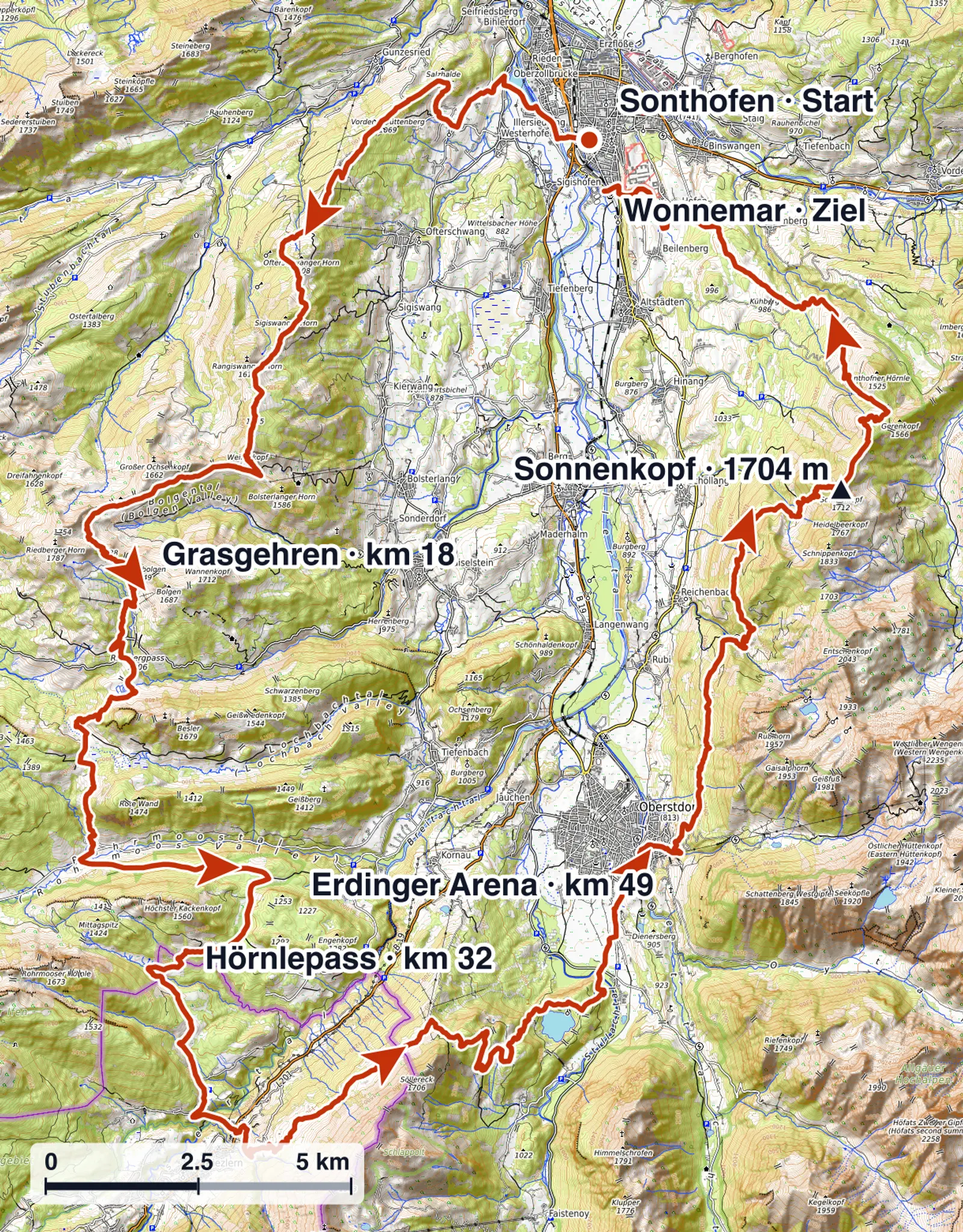
Panorama Marathon Ultra is a long Allgäu mountain tour disguised as a sub-70 km race. The official route is listed at 69.5 km with 3,089 m of ascent. What matters for pacing is simpler: the race still saves its hardest climb for after Oberstdorf.

Course character
The opening is honest immediately. Sonthofen to Grasgehren already builds a full mountain-race workload, then the route keeps changing through Rohrmoos, Hörnlepass and Söllereck before dropping to Erdinger Arena in Oberstdorf. Many runners will read that valley section as relief. It is not relief, only a reset before the decisive late climb.
Four acts, not one continuous profile
It helps to read Panorama Marathon Ultra as four separate race problems.
- Sonthofen to Grasgehren. The opening climb shapes the whole day. If you run the first hour by adrenaline, Grasgehren arrives with damage already done.
- Grasgehren to Söllereck. This middle block alternates climbs, descents and exposed terrain. It rewards rhythm more than heroics.
- Söllereck to Oberstdorf. The course drops toward the 49 km cut-off at Erdinger Arena. This is where overheating and fuelling mistakes often start to show.
- Oberstdorf to Wonnemar. The late climb over Gaisalpe to Sonnenkopfgipfel is the true crux. Only after that does the long descent back to Sonthofen begin.
Key climbs and late-race shape
The route keeps plenty of climbing for the second half. That is why a comfortable first half split can still hide a weak overall pacing choice:
- Sonthofen → Weltcuphüttekm 0–7.8early ramp block
- Weltcuphütte → Grasgehrenkm 7.8–18.2second opening climb
- Rohrmoos → Söllereckkm 24.6–40long middle section
- Erdinger Arena → Sonnenkopfgipfelsteepestkm 49.4–59.5decisive late climb
The defining section is the 10 km block from Erdinger Arena to Sonnenkopfgipfel. On paper it sits late in a race of only 69.5 km. In practice it lands exactly when heat, accumulated eccentric damage and looming cut-offs start to distort decision-making.
Surface, shoe choice and the price of the final descent
This is not a soft-trail race from start to finish. Gravel, hardpack, asphalt and technical sections mix in a way that makes the second half especially expensive for the legs.
- A stable trail shoe that stays calm on firm ground is often a better bet than a very aggressive mud-oriented outsole.
- The long descents punish shoes that make your feet work too hard on gravel and asphalt.
- The final descent after Altstädter Hof remains runnable, but it still taxes quads and concentration exactly when the day is already long.
For this course, the smarter choice is usually the shoe that keeps the downhills under control, not the one that only feels best on the steepest single trail.

